Description
The Complete Residential Underwriter
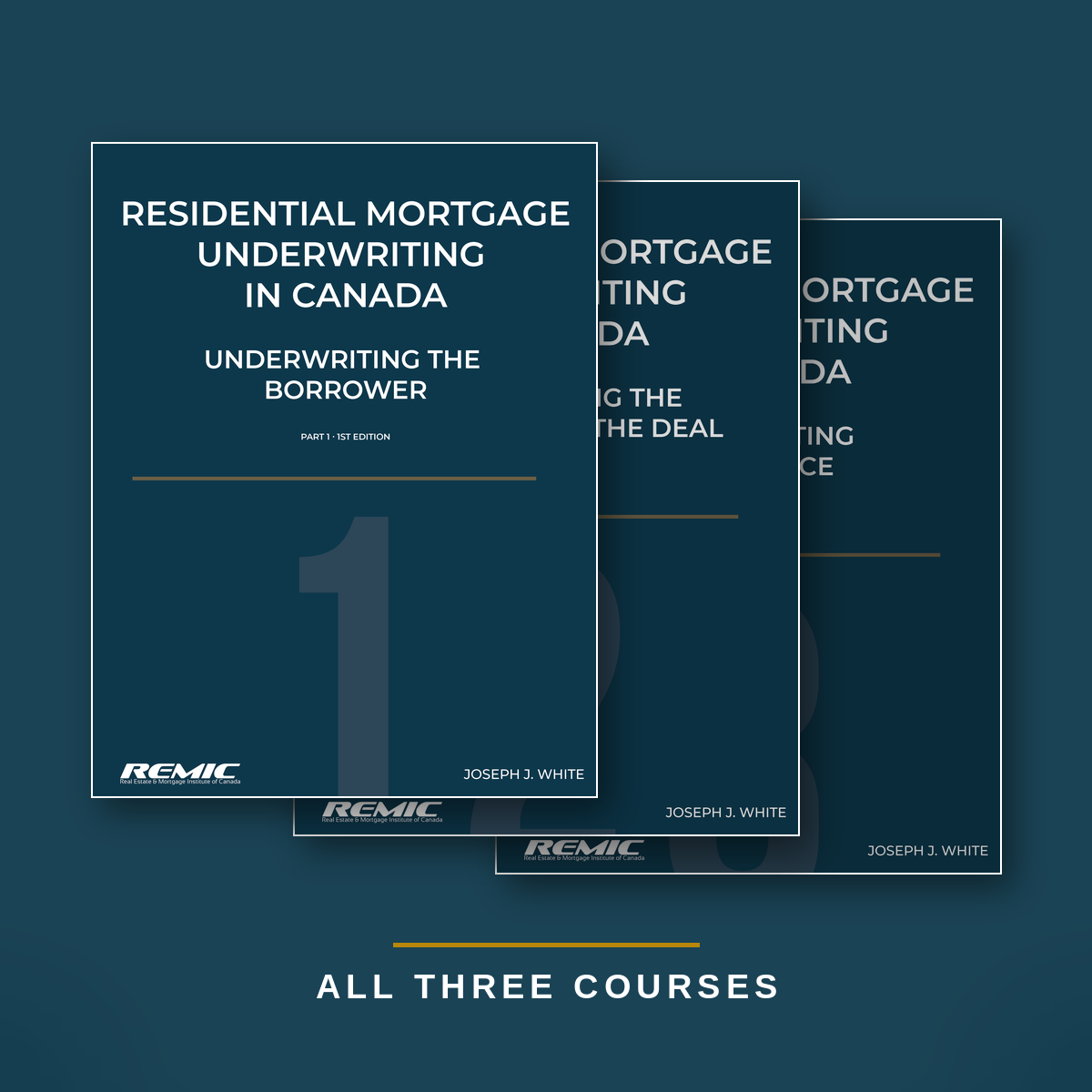
Residential Mortgage Underwriting in Canada, Parts 1 to 3
By Joseph J. White, 2026 edition
There is a gap between holding a mortgage licence and knowing how a file gets approved.
Your licensing course taught you the rules. It did not teach you which self-employed income method gets a borrower qualified, or how to read a status certificate and know the deal is dead, or how to write a decline that still holds up three years later. That knowledge usually takes years to pick up, one painful file at a time.
This program closes that gap. Forty-four chapters across three courses, written for people who do this work every day.
All three, one price
$498 for all three, instead of $1,044
Every course is complete and opens in your account the moment you enrol. All 44 chapters, 45 calculators and decision tools, and the clinic series for each course.
What the three courses cover
Part 1: Underwriting the Borrower
Credit, Income, and Debt Service. Chapters 1 to 14. Most declines come down to the borrower, and this is where you learn to see the problem before you send the file. Credit bureaus, insolvency, income verification, self-employed add-backs, down payment, debt service ratios, co-signers and spousal buyouts.
Part 2: Underwriting the Property and the Deal
Valuation, Property Types, and Deal Structures. Chapters 15 to 28. A strong borrower does not save a weak property. Appraisals, condominiums, rural and agricultural, environmental, title, rentals, newcomer and first-time buyer programs, refinances, construction, bridge and private deals.
Part 3: Underwriting in Practice
Compliance, Risk, and the Professional File. Chapters 29 to 44. The part of the job no licensing course covers. Documentation, fraud, anti-money laundering, privacy, risk assessment, conditions, declines, appeals, portfolio risk, default and foreclosure, mortgage insurance, brokers, ethics and careers.
Live file clinics, every month
The teaching is in the manuals, the videos and the audiobooks. The live nights are for something a book cannot do, which is watching a real file get worked.
Each course runs its own clinic series: four evening sessions a month, two hours each, Tuesday and Thursday over two weeks, 7:00 to 9:00 pm Eastern. Bring a live deal with the names taken off it and we work it in front of the group. Twelve clinic nights across the program, and you can attend any cohort as many times as you like while your access lasts.
Every session is recorded, so a closing never costs you a night. Clinics are led by REMIC instructors, including Joe White and Kevin Rallings.
The certificate
Each course carries a Certificate of Completion. Complete all three and you earn the Certificate in Residential Mortgage Underwriting, which names the full discipline rather than a single course. It goes on a resume, a LinkedIn profile or an email signature.
To be clear about what it is: a certificate of completion covering 44 chapters of material, not a designation, and there is no proctored exam behind it.
Why take all three
The parts build. Part 1 teaches you to qualify a borrower. Part 2 shows you what happens when that borrower buys something unusual. Part 3 teaches you what a lender does with the file afterward, which is what tells you how to send it in the first place.
Take them in order if you are starting out. If you are already working, start with the one that matches the files giving you trouble.
Who this is for
Mortgage brokers and agents who underwrite their own files before submitting them, and underwriters, fulfilment staff and team leads at lenders. You do not need underwriting experience to start.
Full curriculum, all 44 chapters
Part 1: Underwriting the Borrower
- Chapter 1: The Evolution of Canadian Mortgage Underwriting
- Chapter 2: The Modern Underwriting Profession
- Chapter 3: Regulatory Framework
- Chapter 4: Types of Lenders and Their Underwriting Approaches
- Chapter 5: Mortgage Products and Programs Overview
- Chapter 6: Credit Analysis and Bureau Interpretation
- Chapter 7: Bankruptcy and Consumer Proposals
- Chapter 8: Income Verification and Analysis in the Modern Economy
- Chapter 9: Self-Employed Borrowers
- Chapter 10: Down Payment and Gift Fund Verification
- Chapter 11: Debt Service Ratios and Calculations
- Chapter 12: Guarantors and Co-Signers
- Chapter 13: Extended Family Financing
- Chapter 14: Spousal Buyouts and Matrimonial Homes
Part 2: Underwriting the Property and the Deal
- Chapter 15: Property Types and Underwriting
- Chapter 16: Appraisals and Property Valuation
- Chapter 17: Condominium Mortgages
- Chapter 18: Rural and Agricultural Properties
- Chapter 19: Environmental Considerations
- Chapter 20: Title Insurance and Legal Issues
- Chapter 21: Investment and Rental Properties
- Chapter 22: New to Canada Program
- Chapter 23: First-Time Home Buyer Programs
- Chapter 24: Refinances and Equity Take-Outs
- Chapter 25: Construction and Draw Mortgages
- Chapter 26: Bridge Financing
- Chapter 27: Private Mortgages
- Chapter 28: Commercial Mortgages, Basics for Residential Underwriters
Part 3: Underwriting in Practice
- Chapter 29: Documentation Standards
- Chapter 30: Fraud Detection and Prevention
- Chapter 31: Anti-Money Laundering
- Chapter 32: Privacy and Information Security
- Chapter 33: Underwriting Process Flow
- Chapter 34: Technology in Underwriting
- Chapter 35: Communication Skills
- Chapter 36: Declining Applications Professionally
- Chapter 37: Appeals and Second Reviews
- Chapter 38: Portfolio Management
- Chapter 39: Default Management and Foreclosure
- Chapter 40: Mortgage Insurance
- Chapter 41: Working with Brokers
- Chapter 42: Career Development
- Chapter 43: Ethics in Mortgage Underwriting
- Chapter 44: Market Trends and Innovation
Every chapter includes: learning objectives, worked examples with real numbers, Real Talk industry insight, quick reference tables, an interactive calculator, a cheat sheet and a chapter quiz with unlimited attempts.
What’s included
- Three course manuals. Plus every chapter as its own PDF so you can pull up one topic without the whole book.
- 45 calculators and decision tools. Debt service, premiums, buyouts, proceeds, FINTRAC reporting and more. Built to use on live files.
- Live file clinics for all three courses. Twelve evening sessions across the program, recorded and posted within a day.
- Chapter cheat sheets. One page per chapter, 44 in total.
- Chapter quizzes. Unlimited attempts, with feedback that explains why an answer is wrong and where to look it up.
- Video walkthroughs. A short introduction to every chapter from Joe White.
- Audiobooks. Every chapter narrated for the car, the walk or the gym.
- Cait, your AI tutor. Ask questions about the material and get answers at any hour.
- The Certificate in Residential Mortgage Underwriting. Awarded on completing all three courses, plus a Certificate of Completion for each one along the way.
- One year of access to all three. Start any time. Nothing to schedule at checkout.
Continuing education
In Ontario, each course covers your full 10-hour Technical Knowledge and Professional Development requirement (Professional CE) for a FSRA cycle. Hours beyond the minimum do not carry forward, so the three courses cover three cycles rather than thirty hours at once.
Your certificate shows the course name, provider, hours and completion date, which is exactly what you report at renewal. Keep it for four years.
FSRA does not accredit Professional CE courses, so no course can be described as FSRA-approved for this component. You choose your own courses and confirm the hours at renewal.
The hours come from the courses themselves, so clinic attendance is optional and your CE does not depend on it.
Licensed outside Ontario? Contact us and we will confirm what applies in your province.
How do I work through three courses?
All three open in your account the moment you enrol, so you can start anywhere.
If you are new to underwriting, work in order. Part 1 teaches you to qualify a borrower, Part 2 shows you what happens when that borrower buys something unusual, and Part 3 teaches you what a lender does with the file afterward.
If you are already working, start with the course that matches the files giving you trouble. Nothing assumes you have finished the others.
Your year of access covers all three, and the clinic series for each one runs every month, so there is no rush and no fixed order.
About the author
Joe White has spent close to thirty years in the Canadian mortgage industry and has taught more mortgage professionals than anyone else in the country. He founded REMIC, developed Ontario’s first mortgage broker education program, and wrote the Ontario mortgage licensing textbook now in its 16th edition. He was inducted into the Canadian Mortgage Hall of Fame in 2019.
Prefer one course at a time?
Each course can be bought on its own: Part 1 at $298, Part 2 at $348, Part 3 at $398. All three together are $498, which is less than any two bought separately. See the full program.